
CALIFORNIA BEARING RATIO TEST
1. Objective CBR is the ratio expressed in percentage of force per unit area required to penetrate a soil mass with a standard circular plunger of 50 mm diameter at the rate of 1.25 mm/min to that required for
corresponding penetration in a standard material. The ratio is usually determined for penetration of 2.5
and 5 mm . When the ratio at 5 mm is consistently higher than that at 2.5 mm, the ratio at 5 mm is
used. The following table gives the standard loads adopted for different penetrations for the standard material
with a C.B.R. value of 100%.
Penetration of Plunger (mm) Standard Load (kg)
2.5 1370
5.0 2055
Table 1 : Standard Load Values at Penetration For Railway Formation purpose, the test is performed on remoulded specimens which are compacted dynamically. The methodology covers the laboratory method for the determination of C.B.R. of remoulded /compacted soil specimens in soaked state.
2. Apparatus Required Fig. 1: CBR Test Apparatus Consisting of Loading machine with capacity of at least 5000 kg and equipped with a movable head or base which enables Plunger of 50 mm dia. to penetrate into
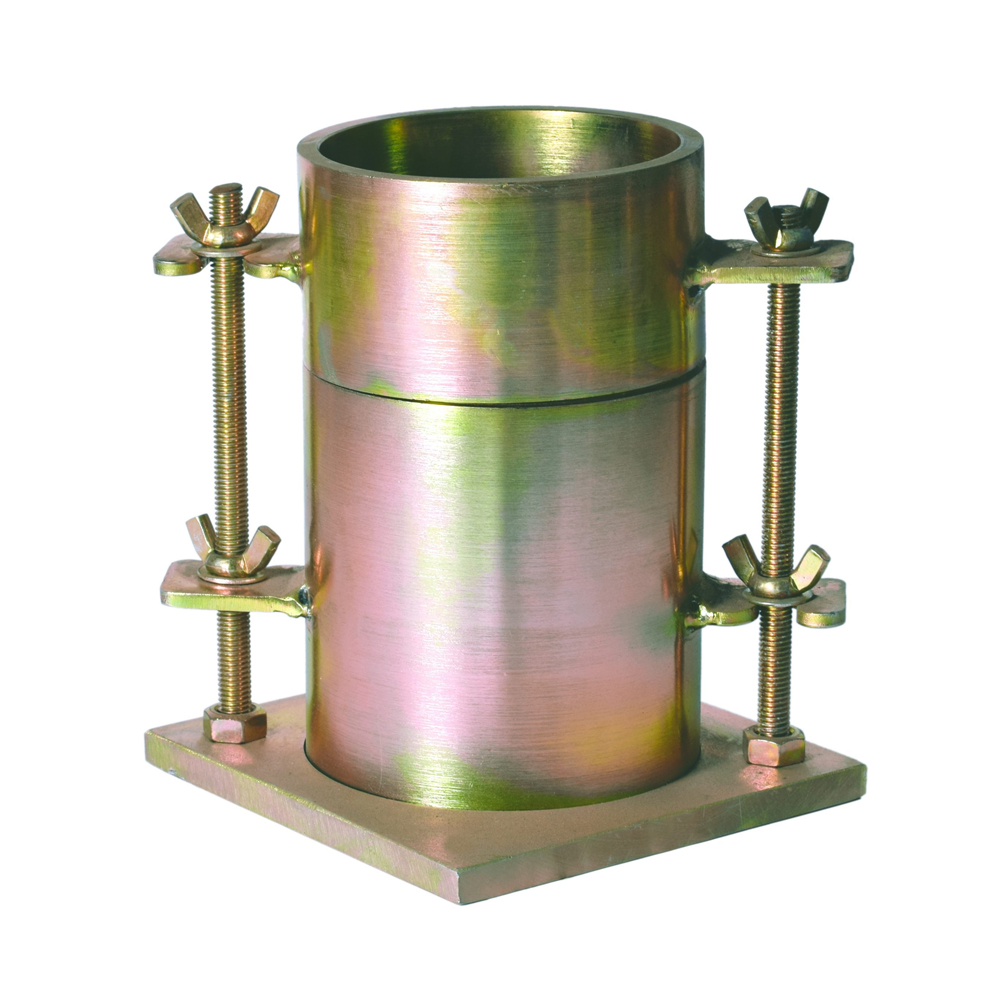
the specimen at a rate of 1.25 mm/ minute. Fig. 2: CBR Mould with Base Plate, Stay Rod and Wing Nut
Cylindrical mould: Inside dia. 150mm and height 175mm with a detachable perforated base plate of 235mm dia. and 10mm thickness. Net capacity – 2250 ml; conforming to IS-9669:1980 (Reaffirmed-2016). Collar
A detachable extension collar of 60 mm height. Spacer Disc 148 mm in diameter and 47.7 mm in height along with handle. Weights One annular metal weight and several slotted weights weighing 2.5 kg each, 147 mm in diameter, with a central hole 53 mm in diameter.
Fig. 3: Compaction Rammer Weight – 4.89 kg with a drop 450 mm. 3. Reference
IS 2720(Part 16):1987 Methods of test for soils: Laboratory determination of CBR (second revision).
Reaffirmed- Dec 2016. RDSO report No. RDSO/2009/GE: G-0014 – Guidelines and Specification for Design of Formation for Heavy Axle Load. 4. Procedure Preparation Of Test Specimen:
1. Remoulded specimen: The test material should pass 19 mm IS sieve and retained on 4.75 mm IS
sieve. The dry density for a remoulding shall be either the field density or the value of the maximum
dry density estimated by the compaction test (Heavy Compaction Test as per IS 2720 (Part-8) –
1983, for Railway Formation). The water content used for compaction shall be the optimum water
content or the field moisture as the case may be.
2. Dynamic Compaction: A representative sample of the soil weighing approximately 4.5 kg or more for
fine grained soil and 5.5 kg or more for granular soil shall be taken and mixed thoroughly with water.
If the soil is to be compacted to the maximum dry density at the optimum moisture content, the
exact mass of the soil required shall be taken and the necessary quantity of water added so that the
water content of the soil sample is equal to the determined optimum moisture content.
3. Fix the extension collar and the base plate to the mould. Insert the spacer disc over the base. Place
the filter paper on the top of the spacer disc.
4. Apply Lubricating Oil to the inner side of the mould. Compact the mix soil in the mould using heavy
compaction. i.e. compact the soil in 5 layers with 55 blows to each layer by the 4.89 kg rammer.
5. Remove the extension collar and trim the compacted soil carefully at the level of top of mould, by
means of a straight edge. Any holes developed on the surface of the compacted soil by removal of
the coarse material, shall be patched with the smaller size material. Remove the perforated base
plate, Spacer disc and filter paper and record the mass of the mould and compacted soil specimen.
Place a disc of coarse filter paper on the perforated base plate, invert the mould and compacted soil
and clamp the perforated base plate to the mould with the compacted soil in contact with the filter
paper.
6. Place a filter paper over the specimen and place perforated plate on the compacted soil specimen in
the mould. Put annular weights to produce a surcharge equal to weight of base material and
pavement, to the nearest 2.5 kg.
7. Immerse the mould assembly and weights in a tank of water and soak it for 96 hours. Mount the
tripod for expansion measuring device on the edge of the mould and record initial dial gauge reading.
Note down the readings every day against time of reading. A constant water level shall be maintained
in the tank throughout the period.
8. At the end of soaking period, note down the final reading of the dial gauge and take the mould out of
water tank.
9. Remove the free water collected in the mould and allow the specimen to drain for 15 minutes.
Remove the perforated plate and the top filter paper. Weigh the soaked soil sample and record the
weight.